100 AI Prompts for UX Research
- Philip Burgess
- Aug 20, 2025
- 3 min read

By Philip Burgess - UX Research Leader
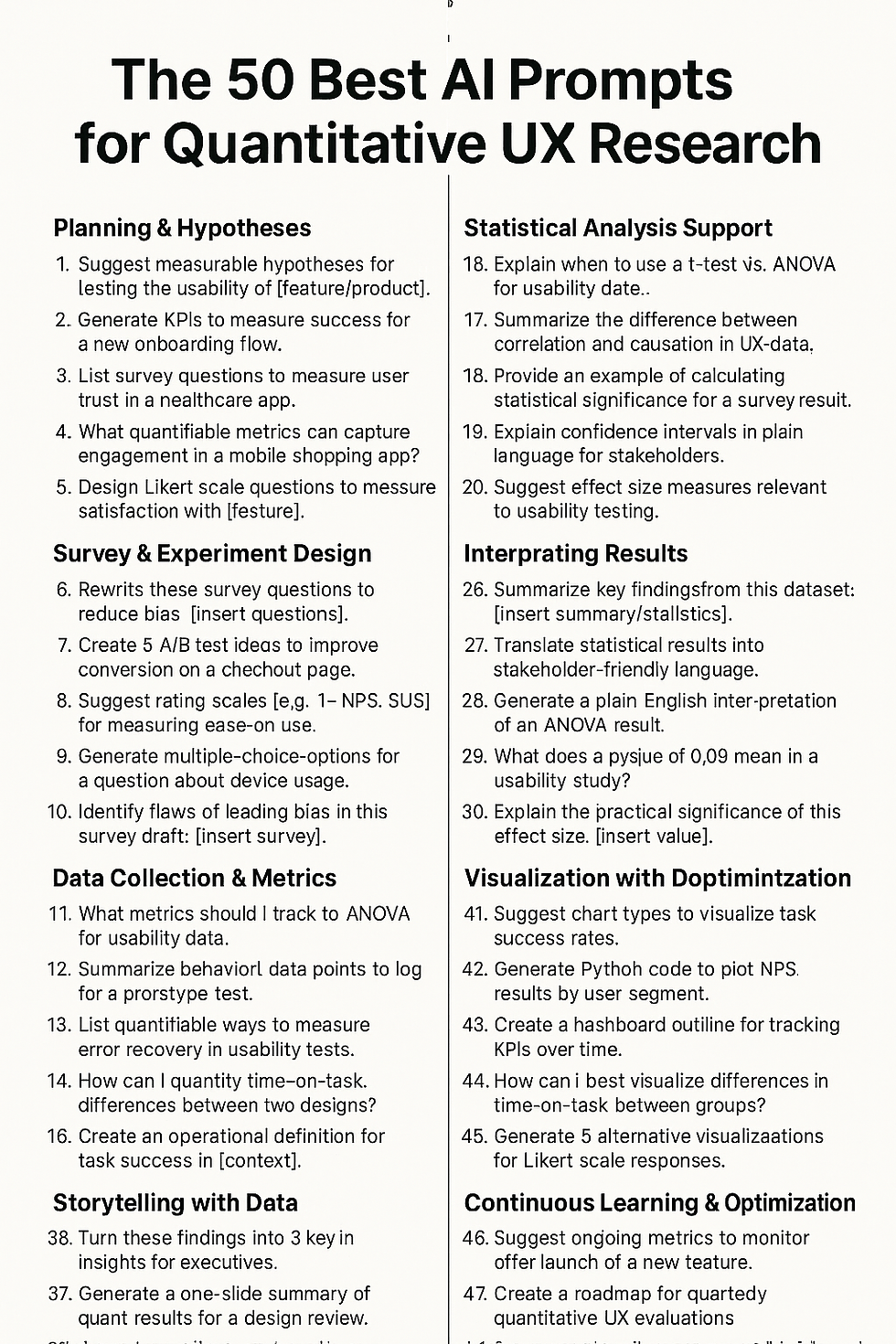
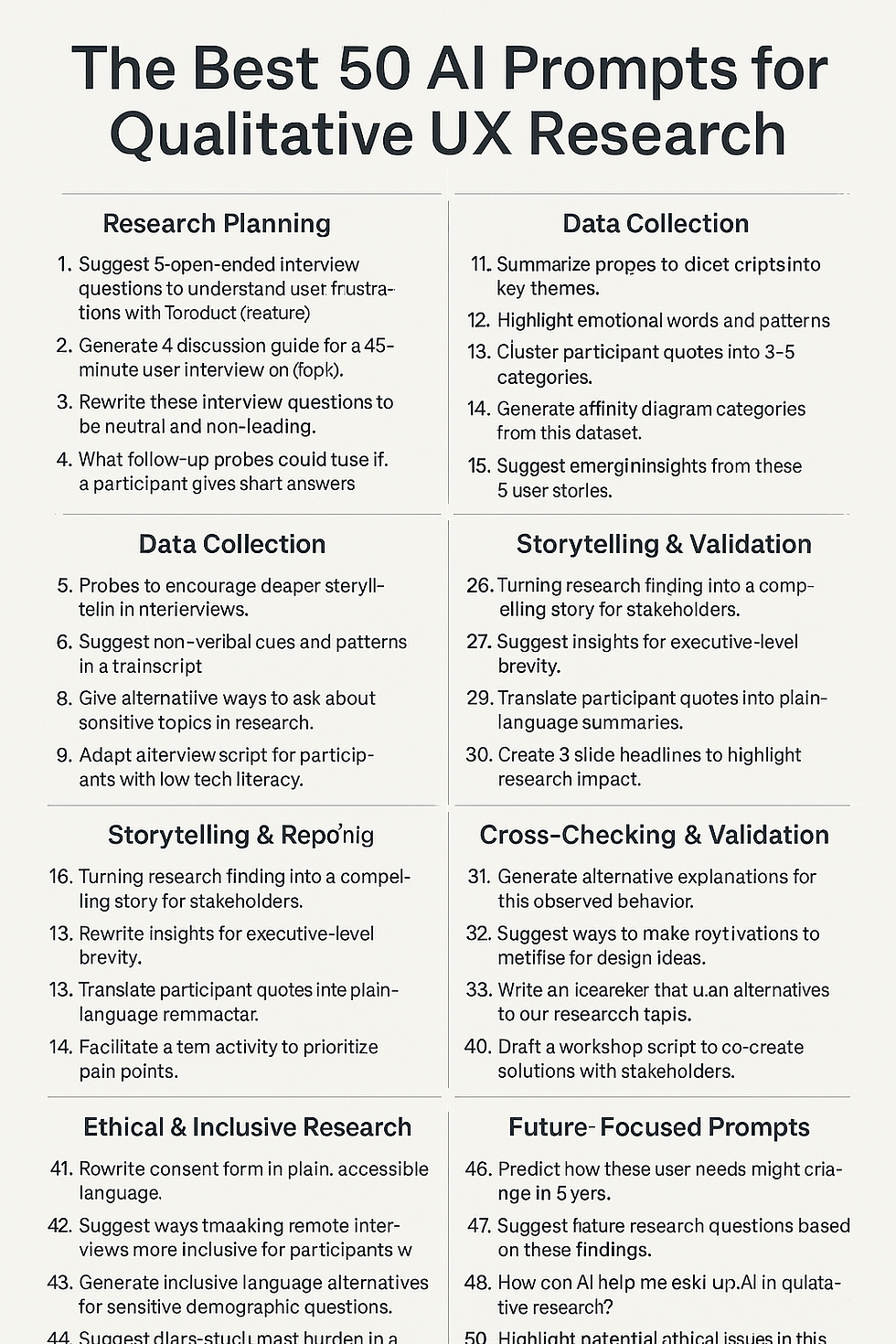
AI is quickly becoming an essential partner for UX researchers. From brainstorming research questions to synthesizing findings, the right prompts can unlock faster insights and help teams scale research impact. Below is a curated list of 100 AI prompts for UX research, organized into categories you can use throughout the research lifecycle.
Research Planning & Strategy
Generate research questions about [specific feature/product].
Create a hypothesis for why users struggle with [task].
Suggest measurable KPIs for evaluating [new design].
Draft a research plan for testing [prototype].
List possible objectives for a usability test of [workflow].
Translate business goals into user-focused research questions.
Identify potential biases in my planned study.
Recommend research methods for evaluating [mobile app feature].
Write a consent form for a usability study.
Compare pros and cons of moderated vs. unmoderated testing.
Recruiting & Screeners
Draft a screener survey for participants who use [product category].
Suggest participant criteria for testing [healthcare portal].
Create a recruitment ad that feels approachable and trustworthy.
Write inclusion and exclusion criteria for [specific study].
Suggest questions to identify heavy vs. light users.
Draft a recruitment email for potential participants.
Create a consent checklist for minors in research.
Recommend diversity considerations for participant recruitment.
Write a screening question to filter for [behavior].
Provide ethical considerations for participant incentives.
Test Design & Tasks
Create realistic usability tasks for [checkout flow].
Draft success criteria for a navigation test.
Suggest open-ended questions for a concept test.
Write 5 task scenarios for a new mobile sign-up process.
Generate probing questions for usability interviews.
Draft confidence-rating follow-up questions.
Suggest emotional probing questions for product satisfaction.
Create comparative task scenarios for [two prototypes].
Recommend task ordering to reduce bias.
Write time-on-task measurement instructions.
Interview & Moderation
Create an introduction script for interviews.
Draft icebreaker questions for participants.
Suggest ways to encourage honest feedback.
Write probing questions for when users say “I don’t know.”
Draft a script for testing low-fidelity prototypes.
Suggest neutral ways to respond to participant confusion.
Provide sample wrap-up questions for interviews.
Generate follow-up prompts to explore unmet needs.
Draft ways to encourage think-aloud during tasks.
Suggest strategies for handling dominant participants in groups.
Data Analysis & Synthesis
Generate affinity mapping themes from these notes [paste notes].
Suggest clusters of insights based on these user quotes [paste quotes].
Summarize key findings from interview transcripts.
Identify patterns in pain points from [list of issues].
Draft user journey stages based on feedback.
Suggest personas based on these behaviors [paste data].
Write a summary of usability issues by severity.
Highlight contradictions in participant feedback.
Turn messy notes into a structured findings doc.
Recommend metrics to track recurring issues.
Reporting & Communication
Draft an executive summary of this research [paste findings].
Suggest headlines for key insights slides.
Turn findings into a 1-page infographic.
Translate usability data into ROI-focused statements.
Write a compelling narrative for a case study.
Suggest ways to communicate findings to developers.
Create a 5-minute presentation outline for executives.
Draft bullet points for stakeholder email updates.
Write analogies to explain usability issues to non-designers.
Recommend visualization types for presenting data.
Ideation & Recommendations
Suggest design solutions for users struggling with [feature].
Generate “How might we” questions from this insight [paste insight].
Draft opportunity areas from research findings.
Suggest feature improvements based on usability test results.
Provide competitor analysis of [feature].
Recommend prioritization for solving usability issues.
Draft hypotheses for A/B testing.
Suggest quick wins for improving satisfaction.
Write problem statements for design sprints.
Generate divergent ideas for solving [user pain point].
Continuous Research & Ops
Recommend templates for standardizing reports.
Suggest ways to reduce participant drop-off.
Draft a research repository taxonomy.
Suggest tagging strategies for storing insights.
Create best practices for research handoff to design.
Recommend metrics for measuring research team impact.
Draft a research ops checklist.
Suggest onboarding training for new researchers.
Write a standard script for recruiting phone calls.
Provide a risk mitigation plan for studies.
Stakeholder Engagement
Suggest ways to evangelize research internally.
Draft prompts for stakeholder interviews.
Write arguments for why usability testing matters.
Generate ROI examples of past UX research.
Suggest workshop agendas for cross-team ideation.
Draft questions to align stakeholders on goals.
Provide strategies for handling conflicting opinions.
Write persuasive copy about the value of research.
Suggest analogies to explain usability to executives.
Generate FAQs stakeholders may ask about research.
Future & AI in UX Research
Draft ideas for integrating AI into participant recruitment.
Suggest AI-driven methods for analyzing qualitative data.
Write ethical considerations for AI in UX research.
Compare human vs. AI-led moderation pros/cons.
Draft prompts for AI to generate usability scenarios.
Suggest ways to use AI for accessibility testing.
Generate workflows combining human insight + AI synthesis.
Predict how AI will evolve UX research roles.
Write workshop prompts to co-create with AI tools.
Create a future vision of research in the AI era.

Comments